

Cold watermelon, sliced into thick wedges with juice running down your chin, is one of summer’s great pleasures. Sweet, crisp and refreshing, it needs little more than a hot day to make it irresistible.
And those same qualities make watermelon a fantastic ingredient for savory dishes.
Pair it with salty feta, peppery arugula, lime juice, olive oil, sumac, and a little heat from red pepper flakes, and watermelon moves effortlessly from afternoon snack to a spectacular salad.
It’s colorful, dramatic, and wonderfully refreshing. The magic is in the contrasts: sweet and salty, juicy and creamy, cool and peppery. Every ingredient brings something different to the platter, yet watermelon remains unmistakably the star.
It’s proof that watermelon deserves a place at the dinner table, too.
Summer cooking, you’ve got this.
Watermelon Has Been Cooling Us Down for Thousands of Years
Ancient Egyptian evidence shows that people were cultivating watermelon thousands of years ago, long before it became the refreshing centerpiece of backyard BBQs.
The watermelon we know today as Citrullus lanatus belongs to the same botanical family as cucumbers, squash and pumpkins. Its ancient relatives, however, weren’t necessarily the juicy, red watermelons piled high at today’s summer produce stands. Their flesh was likely paler and firmer, and instead of the sweetness we associate with watermelon today, many had a distinctly bitter taste.
But what made this fruit a much-loved fruit is there in its name: water. In hot, dry climates, its thick rind protected the watery flesh inside, essentially creating a natural container for hydration. From Africa, watermelon traveled through trade, agriculture and migration into the Mediterranean, Middle East, Asia, Europe and, much later, the Americas.
Over generations, farmers selectively bred and crossbred watermelons for traits such as sweeter flesh, better texture, deeper color, and eventually seedlessness.
That cold wedge of watermelon at your summer picnic comes with quite a résumé.
Why Do We Put Salt on Watermelon?
Here’s where watermelon’s story gets really interesting.
Think about what you instinctively do with different summer fruits.
Taste a tart strawberry or raspberry and you might reach for a little sugar. Taste watermelon and you instinctively reach for the salt shaker.
Why?
It isn’t simply because berries contain less sugar or watermelon contains more. Our perception of sweetness depends on much more than the amount of sugar in a fruit.
Strawberries and raspberries have noticeable acidity. Adding sugar shifts the balance between sweet and sour, softening the tartness and making the fruit taste rounder and sweeter. It’s one reason strawberries macerated with a little sugar are so delicious.
Watermelon is different.
It’s extraordinarily high in water and relatively low in acidity. Its character comes from the combination of sweetness, delicate melon aromas, crisp texture and all that glorious juice.
It doesn’t necessarily need more sugar.
It needs contrast.
At low concentrations, salt can suppress our perception of bitterness while enhancing our perception of other flavors, including sweetness. A small amount of salt on watermelon doesn’t have to make the fruit taste salty. Instead, the watermelon can simply taste more intense.
In other words, salt turns up the volume.
That’s why lightly salting watermelon works—and it helps explain why salty feta is such a natural partner.
Why Watermelon and Feta Salad Just Works
Watermelon and salty cheese have long been enjoyed together in parts of the Mediterranean and Middle East. This modern composed watermelon and feta salad builds on that wonderfully simple pairing.
Watermelon gives you sweetness, abundant juiciness, and crisp texture. Feta brings concentrated salt, tang and creamy richness.
Put them together and the feta does more than provide a salty counterpoint. It essentially seasons the watermelon with every bite.
The salt makes the fruit’s flavor more vivid, while the cool, juicy watermelon refreshes the palate after the rich, briny cheese.
Then the rest of this salad builds on that contrast.
Peppery arugula gives the watermelon a savory backdrop. Red onion adds a sharp little bite. Lime supplies the acidity watermelon naturally lacks. Olive oil adds richness. Sumac reinforces the tartness of the lime, and red pepper flakes provide an occasional flicker of heat.
Nothing is there simply for decoration. Every ingredient has a job.
Salt Your Watermelon—Yes, Really
Before building the salad, place the cold watermelon cubes in a colander, set the colander in a bowl or on top of a plate, sprinkle them lightly with flaky sea salt and let them sit for about 10 minutes.
As already mentioned, that small amount of salt heightens the watermelon’s flavor and brings its sweetness forward.
There’s a practical benefit, too.
The salt encourages some excess juice to leave the watermelon before it reaches your serving platter—and that matters, because watermelon salad has one notorious party trick: turning into watermelon soup.
After about 10 minutes, give the colander a gentle shake. Don’t rinse the watermelon and don’t squeeze or pat it dry. You still want those cubes gloriously juicy.
And all that juice runoff? Enjoy it.
Watermelon Needs Acid—But Not Too Much
Remember that difference between berries and watermelon?
Watermelon’s relatively low acidity is one reason a little lime works so well here. You’re supplying a flavor element the fruit doesn’t naturally have in abundance. But restraint matters. This isn’t a lime salad.
The arugula gets a light toss with fresh lime juice and extra-virgin olive oil before it goes onto the platter. That acidity wakes up the peppery greens and provides brightness underneath the watermelon without coating the fruit in an aggressive vinaigrette. A little additional lime can season the finished platter.
Add a generous drizzle of good extra-virgin olive oil for a luxurious richness that rounds out the sharp lime juice, perfectly bridging the gap between the crisp watermelon, salty feta, and peppery greens.
Sumac and Red Pepper Flakes Bring the Unexpected
Then come two small finishing touches.
First, sumac.
This deep reddish-purple spice is made from dried and ground sumac berries and has a tart, fruity, almost lemony character. A light dusting reinforces the acidity in the salad without requiring a heavy hand with the lime. And gives it a beautiful color.
If sumac isn’t already hanging out in your spice cabinet, don’t let that stop you from making the salad. Simply leave it out. But it’s a fun spice to discover, and once you have it, you’ll find plenty of other places to use it.
Then scatter on a few red pepper flakes. The goal is an occasional flicker of heat.
Against cold, juicy fruit and creamy feta, that little spark of heat is surprisingly irresistible.
Cold Is Also an Ingredient
Temperature matters here.
Keep the watermelon cold. Keep the feta cold. Keep the arugula refrigerated until you’re ready to assemble.
Then build the salad shortly before serving.
Once salt and lime hit watermelon, the clock starts ticking. The fruit will continue releasing juice and the arugula will eventually wilt.
This isn’t a salad I’d assemble at noon for a 6 p.m. dinner.
You can absolutely prep ahead, though. Cube and chill the watermelon, slice, chill, and dry the onion, weigh the feta, and measure your finishing ingredients.
Then compose the platter shortly before everyone comes to the table.
A Summer Salad Built on Contrast
The beauty of this salad isn’t how much is happening. It’s how clearly you can taste everything that is happening.
Sweet, juicy watermelon.
Peppery arugula.
Salty, creamy feta.
Strands of red onion.
Bright lime.
Fruity olive oil.
Tart sumac.
A tiny flash of heat.
And underneath all of it is one of the most useful lessons in cooking: great flavor isn’t always about adding more of what an ingredient already has. Sometimes it’s about adding contrast.
That’s fearless cooking: understanding what an ingredient needs and knowing when you’ve given it enough.
Chef Sandra’s Watermelon and Feta Salad Cooking Tips
- Compose, don’t toss this salad. This isn’t a salad destined for a giant mixing bowl. It’s a composed salad, meaning you arrange the ingredients intentionally on a platter rather than tossing everything together. It should look abundant, relaxed, and a little imperfect. That’s part of its charm.
- Choose the watermelon carefully. This recipe lives or dies by the fruit. Watch my video on how to pick a good watermelon.
- Salt and drain before assembling. Lightly salt the watermelon and let it sit in a colander for about 10 minutes. You’ll heighten its flavor while allowing some excess juice to drain away.
- Buy feta in brine. Feta in brine stays submerged in salted water, preserving its rich, creamy texture and sharp, tangy flavor. Pre-crumbled feta is coated in anti-caking powders to prevent sticking, which dries the cheese out and leaves it with a muted, chalky taste.
- Slice the onion really thin. And, soak the slices briefly in ice water. Then drain and dry them thoroughly to mellow their flavor.
- Dress the arugula lightly. A little lime, olive oil, and tiny hit of kosher salt are all it needs.
- Add a spark of heat. A tiny bit of heat adds another contrasting element that excites your palate.
Frequently Asked Questions
Can I use pre-cut watermelon?
Absolutely. It’s a terrific (but expensive!) shortcut. You’ll need about 2 pounds of trimmed watermelon to give you roughly 6 cups of cubes.
Can I use pre-crumbled feta?
You can, but block feta packed in brine gives you a noticeably creamier texture and a more artistic presentation :).
What can I substitute for sumac?
Nothing needs to replace it. If you don’t have sumac, simply leave it out. The lime already provides acidity, and the salad will still be delicious.
Can I make watermelon and feta salad ahead?
I don’t suggest it. It will quickly turn soggy with the water release from the watermelon. But here’s what you can do: prep the individual ingredients ahead then season and assemble at serving time.
What should I serve with watermelon and feta salad?
Think summer. Grilled chicken, fish, shrimp, pork or steak would all feel right at home beside it. It’s also substantial enough to anchor a light lunch when you don’t feel like cooking.
Bring It to the Table
There’s something wonderfully unfussy about carrying a big platter of watermelon to the table. It doesn’t whisper summer—it announces it.
And maybe that’s the lesson in this salad. Great cooking doesn’t always mean doing more. Sometimes it means understanding what an ingredient is giving you—and knowing what little nudge will make it shine.
For watermelon, that nudge just might be a pinch of salt.
So chill the watermelon. Break out the good feta. Grab your biggest platter. That summer watermelon you usually eat by the slice? Tonight, it’s coming to dinner.
*As an Amazon Associate I earn from qualifying purchases.*
PrintWatermelon and Feta Salad: Sweet, Salty, and a Little Bit Unexpected
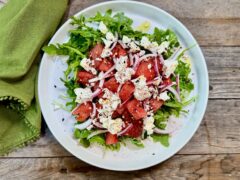
Sweet watermelon, salty feta, peppery arugula, lime, sumac, and red pepper flakes come together in this refreshing, colorful summer salad.
- Prep Time: 15 minutes
- Cook Time: 5 minutes
- Total Time: 20 minutes
- Yield: 6 servings 1x
Ingredients
- 3 cups seedless watermelon
- 4 oz feta cheese
- 3 cups arugula
- 2 teaspoons Maldon sea salt
- 1/4 cup red onion, julienne
- 2 limes
- extra-virgin olive oil
- lime zest
- 1/4 teaspoon sumac
- red pepper flakes to taste
Instructions
- Place the cubed watermelon in a colander over a sheet tray. Sprinkle with 1 teaspoon Maldon sea salt. Let it sit for 10-15 minutes to draw out the juice. Give it a gentle shake before plating.
- Submerge the julienned red onion in a small bowl of ice water for 10 minutes. Drain and pat dry.
- Toss the arugula with a light drizzle (or spritz) of olive oil and a squeeze of fresh lime juice. Season lightly.
- Arrange the dressed arugula over a wide, shallow serving platter.
- Lift the salted watermelon from the colander with your hands and arrange it over the arugula.
- Scatter the red onion over the top.
- Break the feta into pieces by hand and scatter it over the watermelon and red onion.
- Drizzle with olive oil.
- Garnish the salad with fresh lime zest and and a squeeze of fresh lime juice, the remaining Maldon salt, sumac, and red pepper flakes.
- Serve immediately.
Nutrition
- Serving Size: 1 cup
- Calories: 98
- Sugar: 5.9 g
- Sodium: 761.5 mg
- Fat: 6.6 g
- Saturated Fat: 3.2 g
- Trans Fat: 0 g
- Carbohydrates: 7.5 g
- Fiber: 0.6 g
- Protein: 3.5 g
- Cholesterol: 16.8 mg


Top 10 Fruits and Vegetables for Weeknight Cooking
You can make a delicious meal any night of the week with a handful of fresh vegetables and fruits. Get Chef Sandra Lewis' Top 10 Vegetables and Fruits for Weeknight Cooking. Subscribe to our email list below or text COOK to 66866.
You have Successfully Subscribed!
We never, ever share your information.